Current WHO recommendation for yellow fever control
May 17th, 2019Yellow fever vaccine: a global partnership
Current WHO recommendation for yellow fever control
Vaccination is the single most important measure for preventing yellow fever. Yellow fever vaccine is safe and effective and provide immunity within one week in 95% of those vaccinated. Yellow fever control is based on the prevention of outbreaks, and this can only be achieved if the majority of the population is immunized. A two-pronged strategy is used to achieve this goal.
The first strategy is the inclusion of the yellow fever vaccine in national childhood routine immunization programmes, to be administered at 9 months of age, simultaneously with the measles first dose. However, reaching the desired level of population immunity takes more than 30 years with infant routine immunization only, even with a high coverage. Therefore this strategy needs to be combined with the implementation of mass preventive vaccination campaigns to rapidly increase the population immunity and to protect susceptible older age groups in selected high risk areas.
During YF epidemics, reactive vaccination campaigns are carried out with minimum delay in order to limit the spread of the disease.
The International Coordinating Group mechanism
In 2000, a global shortage of yellow fever vaccines for outbreak response arose from the long lead-time needed to produce the vaccine. Moreover, poor surveillance and reporting mask trends and make the forecasting of vaccine needs especially difficult.
WHO and its partners in the International Coordinating Group (ICG) for Vaccine Provision for Epidemic Meningitis Control are applying the ICG strategy and mechanism for the release and use of yellow fever vaccine.
With vaccine manufacturers as partners in the ICG, a stockpile of 2 million doses reserved for outbreaks response was established. The yellow fever ICG sub-group evaluates request for yellow fever vaccine based on agreed criteria for vaccine provision. If the criteria is fulfilled, doses are released from the stockpile for emergency control of the outbreak.
Global emergency yellow fever vaccine stockpile
The GAVI (Global Alliance for Vaccine and Immunization) support
As demands for the use of the stockpile increased, a joint WHO-UNICEF proposal was successfully presented to the Global Alliance for Vaccine and Immunization (GAVI) Board in 2003 for financing an increased global stockpile of 6 million doses per year for a period of 3 years. In July 2005, GAVI support was extended for an additional year until 2006.
Use of the vaccine stockpile
This mechanism will ensure that all available vaccine stocks are directed to the areas of most urgent need and that adequate supplies are manufactured and stockpiled against future outbreaks. Since the accumulation of the first stockpile in August 2003, the GAVI global vaccine stockpile has been successfully used in the outbreaks of urban yellow fever in Cote d’Ivoire, in Colombia, Liberia, Senegal and Sierra Leone.

Côte d’Ivoire: First urban fever epidemic in over a decade
In September 2001, yellow fever cases were confirmed in five of the ten communes in Abidjan; suspected cases were also reported elsewhere. Urban yellow fever, although very rare, can spread extremely rapidly among a dense urban population, causing many thousands of deaths and very serious humanitarian consequences. Over 3.5 million people live in Abidjan – the commercial capital of Cote d’Ivoire.
WHO, working closely with UNICEF, coordinated the international response team with partners in the Global Outbreak Alert and Response Network. An Operations Centre was established at the WHO office in Abidjan to coordinate activities in epidemiology, the immunization campaign, and vector control. Global reserve stock and delivery of vaccines and supplies were through the yellow fever sub-group of the International Coordinating Group for Emergency Vaccine Provision.
Vaccines and safe injection equipment were provided. The mass campaign immunized 2.9 million persons over a 10 day period.
One answer to climate change and the worsening human condition: Camel milk
May 17th, 2019“……But the snorting beasts now have an additional benefit. They are being hailed for their ability to withstand climate-related droughts that are set to worsen in the Horn of Africa, where temperatures average above 30 degrees Celsius parts of the year.
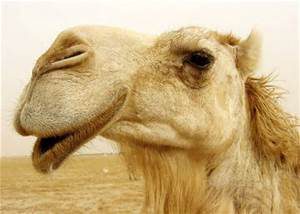
Their milk has been dubbed “white gold” by food experts who say the creamy liquid could help conquer malnutrition, diabetes and other medical concerns, making it a tempting new superfood for health-conscious Western consumers.
With a growth in camel milk products available – from chocolate bars to baby milk formula and ice cream to “camelcino” coffees – there is a growing demand from consumers from North America to China, market experts say.
“If there is water scarcity, (camels) can go a month without water. Even when they are thirsty they can still produce milk – there is no downside to camels,” said Issack who uses money from milk sales to support his family…..
Camel milk is especially nutritious for young children and the elderly, she said, and selling it to passersby has allowed her to pay her debts and her children’s school fees.
The milk, commonly drunk in countries from the United Arab Emirates to Chad and Mongolia, has a vitamin C content three times as rich as cow’s milk, according to the FAO, and can benefit those who lack access to a varied and balanced diet.
“It’s widely claimed that there are lots of medicinal properties to the milk. It’s a different make-up of the proteins, carbohydrates and fatty acids,” said Simpkin.
“That’s what makes people claim that it’s much more nutritious.”………”
“
5/16/1849: The NYC Board of Health establishes a hospital to deal with a cholera epidemic that, before it ends, kills more than 5,000.
May 16th, 2019
Dashboard: International Coordinating Group (ICG) on Vaccine Provision on cholera
May 16th, 2019| Doses shipped by year | |||||||||
| 2018 | 2019 | ||||||||
| 6,323,410 | 1,860,621 | ||||||||
| No. of doses, 2019 | |||||||||
| Requested | 1,372,798 | ||||||||
| Shipped | 1,860,621 | ||||||||
| Mozambique | #1, 2019 | MOH | Approved | Humanitarian crisis | 884,975 | 2 April | 3 April
|
| Zimbabwe | #2, 2019 | MOH | Approved | Humanitarian crisis | 975,646 |
WHO: India harbors 60 percent of the world’s leprosy cases, with more than 100,000 new diagnoses each year.
May 16th, 2019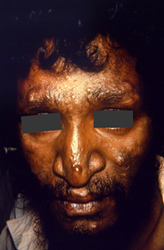
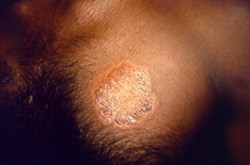
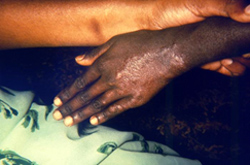
Hansen’s disease is a chronic infectious disease caused by Mycobacterium leprae and usually affects the skin and peripheral nerves, but can have a wide range of possible clinical manifestations.
Patients can be classified into three groups, each with slightly different signs and symptoms:
- Paucibacillary (PB), or tuberculoid, Hansen’s disease is characterized by one or a few hypopigmented or hyperpigmented skin macules that exhibit loss of sensation (anesthesia) due to infection of the peripheral nerves supplying the region. The body’s immune response may also result in swelling of the peripheral nerves; these enlarged nerves may be palpated under the skin, and may or may not be tender to the touch. The nerves most often found to have swelling are:
- Great auricular nerve
- Ulnar nerve above the elbow and dorsal cutaneous branches at the wrist
- Median nerve at the wrist (in the carpal tunnel)
- Radial nerve (superficial at wrist)
- Common peroneal nerve (also femoral cutaneous and lateral popliteal nerves where they wind around the neck of the fibula)
- Posterior tibial nerve, posterior to the medial malleolus
- Sural nerve
- Multibacillary (MB), or lepromatous, Hansen’s disease is characterized by generalized or diffuse involvement of the skin, a thickening of the peripheral nerves under microscopic examination, and has the potential to involve other organs, the eyes, nose, testes, and bone. The nodular form of this condition is the most advanced form of the disease. Ulcerated nodules contain large numbers of M. leprae acid-fast bacilli packed in macrophages that appear as large foamy cells. MB form of Hansen’s disease is associated with:
- multiple, symmetrically-distributed skin lesions that might not exhibit loss of sensation
- nodules
- plaques
- thickened dermis
- frequent involvement of the nasal mucosa resulting in nasal congestion and epistaxis
- Borderline, or dimorphous, Hansen’s disease is the most common form. When compared to tuberculoid or lepromatous forms, it is of intermediate severity. The skin lesions seem to be of the tuberculoid type, but are more numerous, and may be found anywhere on the body. Peripheral nerves are affected as well, with ensuing weakness and anesthesia.
Menstrual Sheds in Nepal
May 16th, 2019“…..Every year in Nepal, women die while sleeping in a shed outside their home because they are on their period. The cause of death is often smoke inhalation from lighting a fire to stay warm.
The practice, called chaupadi….”
People infected with the outbreak strain of E. coli O103, by state of residence, as of May 10, 2019 (n=196)
May 15th, 2019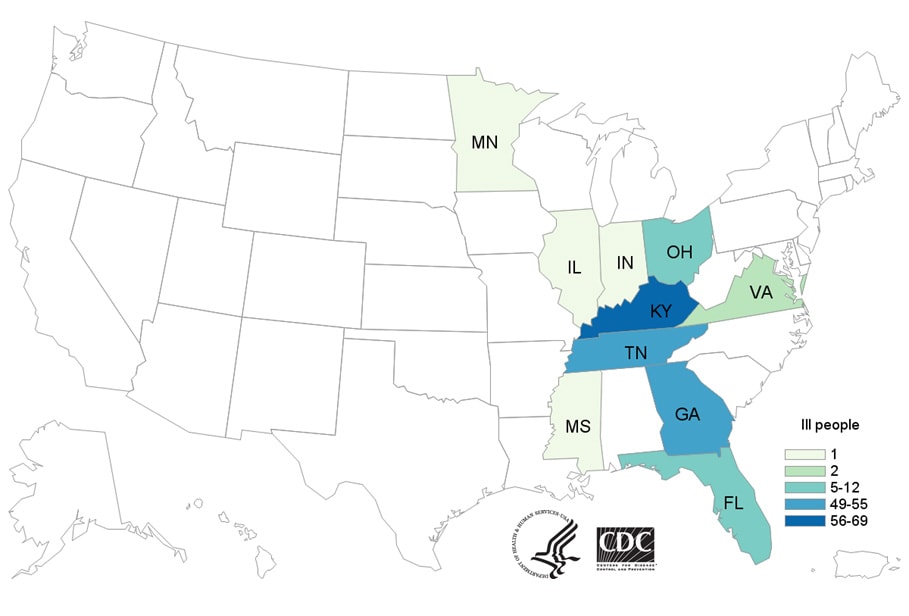
The Mauna Loa Observatory, which has measured the parts per million (ppm) of CO2 in the atmosphere since 1958, took a reading of 415.26ppm in the air on 11 May – thought to be the highest concentration since humans evolved.
May 15th, 2019
Site: https://www.ncdc.noaa.gov/paleo-search/study/6091
DOI: https://doi.org/10.1038/nature06949
Citation: Lüthi, D., M. Le Floch, B. Bereiter, T. Blunier, J.-M. Barnola, U. Siegenthaler, D. Raynaud, J. Jouzel, H. Fischer, K. Kawamura, and T.F. Stocker. 2008. High-resolution carbon dioxide concentration record 650,000-800,000 years before present. Nature, Vol. 453, pp. 379-382, 15 May 2008.
NOAA: Storm surge, the deadliest threat from tropical cyclones
May 14th, 2019
Credit: NOAA
“……These storm surge hazard mapsoffsite link enable people living in hurricane-prone coastal areas to evaluate their risk of coastal flooding due to storm surge. And don’t forget, storm surge is not just a beachfront problem. The hazard extends many miles inland from the immediate coastline in some areas. Understanding this risk gives you the time to take action when emergency managers tell you to evacuate……”
1. Storm surge is often the greatest threat to life and property from a hurricane. It poses a significant threat for drowning. A mere six inches of fast-moving flood water can knock over an adult. It takes only two feet of rushing water to carry away most vehicles— including pickups and SUVs.
2. Storm surge can cause water levels to rise quickly and flood large areas—sometimes in just minutes, and you could be left with no time to take action if you haven’t already evacuated as instructed.
3. Storm surge values do not correspond well to the hurricane wind categories (of the Saffir-Simpson Hurricane Wind Scale) that range from 1 to 5. These categories are based only on winds and do not account for storm surge.
4. Tropical storms, category 1 or 2 hurricanes, major (category 3 to 5) hurricanes, and post-tropical cyclones can all cause life-threatening storm surge.
5. Storm surge can also occur with non-tropical storms like Nor’easters and other winter storms.
6. Many U.S. Gulf and East Coast areas are vulnerable to storm surge, including areas up to several miles inland from the coastline. Find out today, well before a hurricane ever approaches, if you live in a storm surge evacuation zone.
7. Storm surge can occur before, during, or after the center of a storm passes through an area. Storm surge can sometimes cut off evacuation routes, so do not delay leaving if an evacuation is ordered for your area.
8. During the peak of a storm surge event, it is unlikely that emergency responders will be able to reach you if you are in danger.
9. Even if your community is not directly affected by storm surge, it could experience other hazards from the storm and face dangerous conditions such as impassable roads, water and sewage problems, and power outages. If power remains on, downed electrical wires can pose an electrocution risk.
10. Weather conditions and the forecast can change. Local officials could issue evacuation or other instructions for many reasons. Always follow the instructions of local officials.